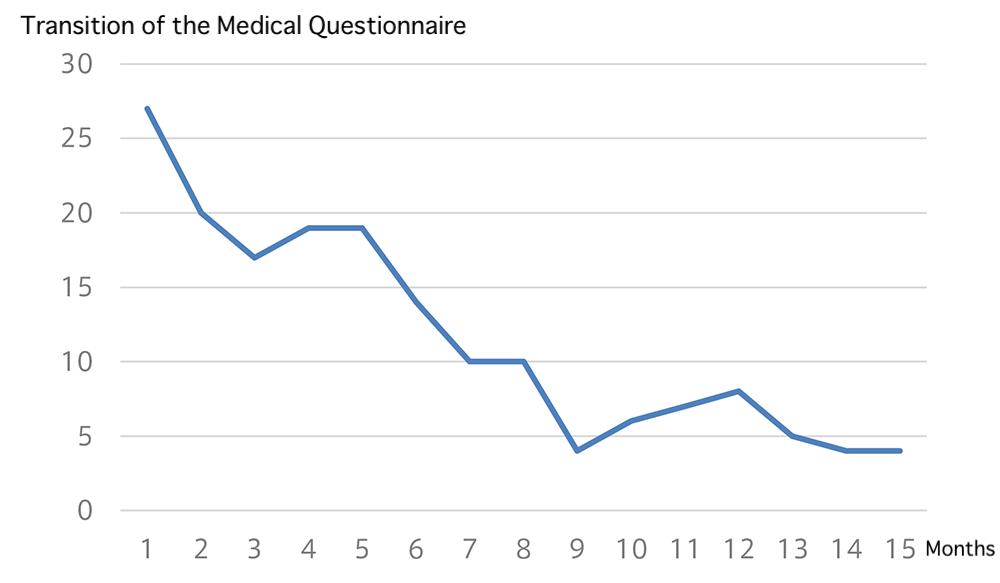
A case in which a patient had previously been hospitalized in a psychiatric hospital multiple times for depression, but did not improve with medication, and visited Matsui Hospital's outpatient clinic, where her symptoms were completely improved with electrical treatment to the neck.
Case No. 086 47-year-old female
Experience record 2024.3.24
History leading up to hospitalization at Matsui Hospital
I'm active, confident in my physical strength, don't catch colds easily, and have never had a serious illness.
I have more energy than most people, and prefer outdoors to indoors.
When I was younger, I moved around a lot, played a lot, and led an active lifestyle.
I gave birth to my first daughter at age 24, followed by my second daughter at age 27. I got divorced at age 28, and we started living as a family of three with our two children, but we were able to live healthy lives every day. About a year after my divorce, I was involved in a rear-end collision while riding in a taxi with my first daughter.
While stopped at a traffic light, my daughter started to fall asleep in my arms, so I lifted her body a little off the seat to hold her again, and when I held her tightly, I was hit from behind. The impact was so strong that I thought my neck would break. When I put my body back in the seat, I noticed that the seat was bulging toward me, and the rear window glass was hanging down on the back of my head. The moment I held my daughter back protected my body. If I had stayed in the seat, I think I would have hurt my back. I was then taken to the hospital by ambulance.
As we got into the ambulance, I could see the back of the taxi. The trunk was flattened, showing the severity of the impact.
Later, the insurance company reported that the car had crashed into us at 60km/h without braking. Fortunately, my daughter was not injured, but I had severe pain in my neck and back and was recommended to be hospitalized, but my eldest daughter did not need hospitalization and we have a second daughter, so we decided to keep her as an outpatient. (The taxi driver had an X-ray taken from an osteopathic clinic before the accident, which proved that the bones in his back were out of place and he has been certified as having a residual disability.)
The pain and fatigue reached their peak a week after the accident, and it got worse day by day. I had to take time off work, and it was hard to do housework or hold my child. I was diagnosed with whiplash, and symptoms remained from my lower back to my neck, and I continued to visit the hospital for more than six months. The fatigue increased along with the pain, and after a month, I was so fatigued from my neck to my arms that I couldn't pick up something that had fallen off my desk.
I tried everything from painkiller injections, oral medication, patches, rehabilitation, and chiropractic treatment, but there was no noticeable improvement, so for about two years I received painkiller injections in my shoulder and went to work.
My mental state at the time was close to depression, and the physical fatigue was pulling on my mind, making me not want to move or go outside, wanting to sleep, being unable to get up in the morning, having no appetite, and even when I slept the fatigue didn't go away, I was always feeling tired and had no energy at all. I slowly recovered from that, and over a long period of time it took to return to my daily life, but the whiplash had made it impossible for me to keep my neck cool.
In winter, of course, but even in summer, you need to be careful about the coldness of air conditioning. After washing your hair, you can't leave it wet because damp hair on your neck can make you feel sluggish. You need to dry it immediately, wear clothes that don't keep your neck cold, wrap a towel around your neck, and take other measures.
With some ingenuity, I was able to regain my energy and become more active, enjoying my daily life at work and playing with my children. I was free from illness and was very active, going on trips and picnics with my children almost every week.
At that time, I was confident in my physical strength, just like when I was younger, and I never thought I would be diagnosed with depression. The 10 years of my 30s were filled with such energy.
Depression
In January 2019, I collapsed at home due to overwork and stress and was taken to the hospital by ambulance. Two days after being taken to the ICU, it was decided that I would be transferred to X Hospital.
During the 10 years I was healthy, I worked in a construction company, where I was in charge of accounting. The work was busy but fulfilling, and I was promoted smoothly. In 2018, I joined the Chamber of Commerce at the behest of the president. In addition to my regular work, the number of Chamber of Commerce activities increased, which made me even more overworked.
My regular job was so busy that I had to take my children to work on weekends, and many of the Chamber of Commerce's activities were held at night, so I inevitably got less sleep. My average sleep time that year was around 2-4 hours.
I joined the Chamber of Commerce in April, and about six months later, I began to suffer power harassment from the chairman and his wife, who were dissatisfied with my performance at work.
It seems that the cause was that I had been going out more often with the Chamber of Commerce, and had made connections with other companies.
Assuming that I was doing something bad outside, they began making up allegations and demanding that I resign.
The president's opinion was that the chairman should be left alone, and he insisted that I should not resign, so nothing was resolved and I was caught in the middle. Around this time, I started to feel something was wrong with my health. I had stomach ulcers, loss of appetite, weight loss, tinnitus, orthostatic disorder, trembling hands and feet, hypoglycemia, etc. However, I didn't think about going to the hospital and just thought I had to somehow get by.
At the end of December, the power harassment reached its peak and I was mentally pushed to the limit. I finally decided that I had no choice but to quit, so I submitted my resignation to the president.
However, my request to quit was rejected and my resignation was discarded.
At this point, I think I had reached my mental limit. Since I couldn't quit, I had to continue working, so I started working again after the New Year. During that time, I collapsed after coming out of the bathroom at home. My daughter arranged for an ambulance, and when I came to, I was in the ICU at the industrial accident hospital.
When I woke up, I had to go to work, what should I do? I wanted to leave the hospital right away, but when I heard the explanation of the hospital I was being transferred to, I was surprised. XX Hospital is a psychiatric hospital? Why? What's wrong with me?
I couldn't understand it for a while. After I was transferred to another hospital, I weighed myself and found that I was 38kg. I hadn't even noticed that I had lost so much weight. And the most troubling thing was that I was not allowed to bring my cell phone into the hospital. This would interfere with my work, and I argued with the doctor, saying that if I couldn't go to work, I should at least have my cell phone, but the cell phone was the worst thing I could do, and he firmly told me that I was stressed out by work, so I'd never get better unless I got away from work! It was only then that I realized that I was in a really bad mental state.
After that, I quietly spent four months in hospital and two months recuperating at home. The treatment was with medication, which got stronger and stronger until I barely remember anything from that time.
I can't even remember what I did every day. But not having to worry about work anymore gave me the impression that I could take a break for the first time in 10 years.
After being discharged from the hospital, I submitted my resignation again, which was accepted and I was accepted at a public scrivener's office. (My job there was to prepare documents 10-12 hours a day.) After two months of recuperating at home, I returned to work, but I didn't have the same energy as before. I didn't know if it was the medicine or the illness that was making me feel sick, and after six months, the hospital decided to hospitalize me again.
I think I spent about two years repeating the cycle of being hospitalized for a few months, being discharged, recovering at home, and then going back to work. I felt bad for my company, and I began to get frustrated with the symptoms that never seemed to get better. I also realized that taking medication was not a fundamental treatment, so I started to wonder if there was another way to cure my condition.
Medicines prescribed by the hospital
Lexotan, Wypax, Solanax, Meilax, Landsend, Belsomra, Etizolam, Benzalin, Silace, Lendormin, Doral, Amovan, Dayvigo, Lunesta, Flunitrazepam
(Depending on the symptoms, the doctor will prescribe a combination of 6 or 7 of these. One for daytime use, one for snacks, and one for bedtime. I found the withdrawal symptoms from Doral to be the toughest.)
Symptoms after being diagnosed with depression
・Pain and fatigue around the neck and shoulders (started going for upper body massages shortly before collapsing)
・Always catching a cold. Has a slight fever (went for tests each time but couldn't identify the cause)
・Dizziness (diagnosed with Meniere's and taken medicine before, but didn't help much)
・Loss of appetite (weight loss)
・Overeating (weight gain)
・Uncomfortable feeling in the throat
・Feeling like someone is squeezing my neck
・Insomnia
・Low blood pressure
・Can't stay in cold places
・No sweating
・Arrhythmia (tests found nothing)
・Eye problems/difficulty seeing (visited eye doctor but prescription not changed much)
・Bright light (always wears sunglasses and a hat)
・Dry eyes (always carries eye drops)
・Dry throat and mouth (always carries a drink)
・Excessive constipation (takes laxatives and constipation supplements)
・Spends a lot of time lying down/needs to take naps
・Fatigue (this is the most troublesome, tests at the obstetrics and gynecology and urology departments found nothing)
・Loss of energy
・Depends on the weather. Rainy days are especially hard
・Feeling depressed (can only think of bad things)
・Constant tinnitus
・When the tinnitus gets stronger, it feels like my head is being squeezed and I can't get out of that state. I'm constantly tense, which leads to insomnia (more medication required)
・Anxiety (trapped by worries about the future, no positive feelings at all, always anxious)
・Cold hands and feet (always warm with a heating pad or hot water bottle)
I felt like I was managing to get by while dealing with the various symptoms, but at my lowest mentally I even contemplated suicide and went so far as to buy a rope.
My physical condition was affecting my mind, and I was no longer able to think positively.
I went to different hospitals every time something happened, but no diagnosis was ever made, and I felt anxious that no solution could be found. I went to so many hospitals that I no longer remember all the ones I had been to.
I had been feeling unwell for a long time and my physical strength was completely worn down. My mental state was not going in a good direction, everything I thought was negative, I was getting more and more depressed, and I couldn't get out of the spiral.
I'm usually the complete opposite, always positive and active, but it was as if my personality had changed.
When I told a friend who knew me when I was healthy that I wasn't getting any better, the friend said it was strange that I had been healthy to begin with, so even taking medication had not helped for so long. The friend looked up my symptoms and told me about Matsui Hospital, which the friend found on the internet.
Can electrical treatment cure this? What is the name of this disease? I was skeptical, but after visiting various hospitals and finding nothing, I decided to go and see a doctor as a last resort.
After the diagnosis
I'm really glad I met Dr. Hara.
At our first appointment, the doctor said, "There's no doubt youI have cervical neuromuscular syndrome!"
So that's what I had, I thought.
I remember feeling so relieved that my long hospital visits had finally come to an end.
I'd finally be cured. Filled with hope, I decided to trust Dr. Hara and try electrical treatment.
I was initially recommended to be hospitalized, but as I have two children at home, I decided to commute from home (Okayama). If I were hospitalized, I would receive electrical treatment twice a day, morning and evening. I couldn't do it every day, but I went two or three times a week as much as I could.
Unlike low-frequency electrical treatment devices found in household appliances, the effects of electrical treatment were immediately noticeable after just one session. My shoulders and back felt immediately relaxed, and I felt like blood flow had improved all the way down to my toes. The feeling of relief was very pleasant, and I felt a temporary sense of relief after it was over.
I think it was this sensation that allowed me to continue going. At first, the pain would return to normal the day after the electrical treatment. Because it made me feel better, I wanted to go even if it meant using the highway, so I had my daughter or a friend drive me two or three times a week. After that, I gradually reduced it to about once a week, then once every two weeks. Now, I can go once every few months without any problems. I may not need to go anymore, but I would like to receive electrical treatment as a preventative measure, both for the comfort it provides and to avoid accumulating fatigue
As the stiffness in my neck and shoulders was relieved, my mental health was quickly relieved.
At first I didn't even have the energy to get out of bed, but after about a month or two, I started to enjoy shopping, go to hot springs, and want to watch movies; little by little, my behavior began to change. After six months, I was visiting Kagawa and doing a little sightseeing before heading home.
I was finding things I wanted, there were more sights I wanted to see, and I was able to think about how to spend my time, which meant I was able to think about the future.
I started to look forward to tomorrow little by little, making plans for the next week and preparing for them, and making an appointment with the hairdresser in a month, and looking forward to it. The future started to look brighter and brighter. A new future was waiting for me, who had only been able to think about suicide. It was a wonderful thing.
Medication for depression treatment puts you under sedation and takes you to a state where you can't think. I think you needed sleeping pills to recover from your extreme fatigue. However, if you stay under sedation for a long time, you lose all thinking ability and even lose the ability to make normal decisions.
Working while still under the influence of drugs is very hard on the body because you have to force yourself to wake up from a sleepy state and make your mind work. To escape from that hardship, I would stop taking the drugs, but then the withdrawal symptoms would prevent me from getting up, so I would have to take time off work, and this cycle would repeat.
Once I started using strong medicine, it took a lot of effort to ease the pain, and I was stuck in a negative loop. My memory is also fragmented, and there are many things I still forget.
Since I started the electrical treatment, my body has become lighter, so I've been able to reduce the amount of medicine I need, and my mind has naturally become clearer, and I feel like I've finally woken up. I feel refreshed both physically and mentally, and I have hope for the future.
Finally,
I think that discovering this disease, its treatment, and Dr. Hara may have saved my life. If this disease had not been discovered, I might still be asleep, and I might not be where I am now. I can spend every day comfortably, eat delicious food, and think about my future and that of my daughters. I can no longer even intuitively recall the pain I have experienced, and I am not even a little anxious.
Course of symptoms